About Me
I’m a series of spacetime events called Ricardo.
You can send me a message or leave anonymous feedback on my contact page.
My Work
My mission is to leverage my talents and interests to positively impact in the world. I see machine learning as a tool to maximize my impact.
For a 1-page summary of my career, please refer to my resume:
For a comprehensive summary, please refer to my CV:
In a past life, I was a molecular biologist. Over the years I researched colon cancer, Parkinson’s disease, olfaction, and organic chemistry. In 2014, while I was working in a computational neuroscience lab, I realized that deep learning was going to change the world and that I could have more impact leveraging automation, and so I decided to specialize in AI.
Websites
You can find me around the web:
- Github
- StackOverflow
- Flickr
- I also have a LinkedIn but beware that I rarely check it because it's too inauthentic.
Publications
See my publications page.
Personal Life
Personality
I expect anyone reading my profile to expect a carefully crafted biography describing where I was raised and what my tribal affiliations are, but I think this information is almost entirely useless. What could you say about me knowing that I am a first generation American born to Cuban and Argentine parents? So instead I'll just post the results of some psychometric tests.
- Myers-Briggs Type: INTP-A, which stands for "Introverted", "iNtuitive", "Thinking", and "Prospecting" traits, Assertive sub-type. Called the "Architect" or "Logician" personality type, depending on the source.
- My BIG5 personality test results
Travel
- I have visited 28+ countries, done 3 major bicycle tours (Seattle ↣ San Francisco, around Taiwan, and around New Zealand), and been to 47 of 50 U.S. states.
- I’ve hitchhiked over 10,000 miles in the US, Taiwan, Thailand, Australia, and New Zealand.
- I converted a jumbo news crew van into a tiny home and lived the van life for 2 years. It had roof solar, a fridge/freezer, and fit everything I owned!
Talks and Interviews
- Talk on Data Curation at the AI in Production Conference ’24.
- Ray Summit ’21: “How Ray and Anyscale Make it Easy to do Massive-scale ML on Aerial Imagery”
- Talk for TA3M Seattle: “How AI can be abused by surveillance states” (presentation slides)
- Interview with KOMO news in Seattle over the net neutrality debate
Volunteering
- See my open source contributions.
- I helped organize a Surveillance Self-Defense Workshop for Activists with TA3M Seattle.
- I organized and led a protest against Congress’s plans to end the Internet’s decentralized nature (downtown Seattle, December 2014).
- I volunteered for 1.5 months for a community in Mota Lava, Vanuatu.
- I volunteered for a whale monitoring survey to study how the world’s largest LPG processing center would affect the world’s largest Humpback whale calving area near James Price Point, Australia.
- I answer coding questions on StackOverflow.
- I contribute to Wikipedia.
Art
- I was Artist in Residence at the Sir James Wallace Arts Trust for a few months in 2015. A selection of my works are in circulation around public spaces in New Zealand. Links to my Flickr below!
- I find the intersection of art and machine learning fascinating. I used to maintain a repository of research projects and use AI art generators.
Professional Projects
Tackling Climate Change Using Automated Afforestation
Dendra Systems - Feb. 2020 → Jan. 2025
I was the founding lead ML engineer at a start-up scaling up ecosystem monitoring and restoration using AI, swarms of tree-planting drones.
Improving Remote Monitoring of Cardiac Patients by Automatically Detecting Arrythmias
Pacemate - Feb. 2019 → Dec. 2019
I worked as the lead data scientist at an implantable heart device analytics company. I implemented a pipeline to process incoming ECG transmissions from remote devices and classify arrythmias using a deep convolutional neural network. To train this network, I mined years of ground truth data labeled by board-certified electrophysiologists.
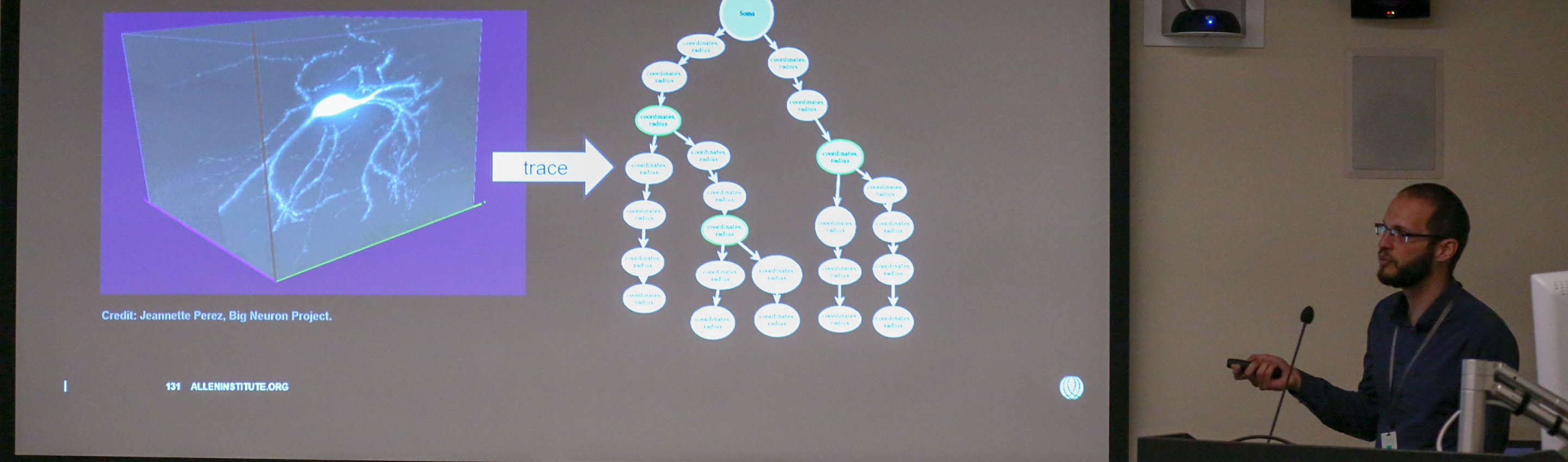
Reinforcement Learning for Tracing Neuron Morphologies
Hanchuan Peng lab. Allen Institute for Brain Science, Seattle, WA, USA - Summer 2018
I made a proof of concept showing that deep reinforcement learning can be used to automatically trace neuron morphologies.
Mosquito thermal plume tracking
Adrienne Fairhall lab. University of Washington, Dept. of Physiology and Biophysics, Seattle, WA, USA - 2014 → 2016
I worked as a research assistant in Fairhall Lab. We’re interested in answering how the history of sensory experience affects decision-making. As a model, we use mosquitoes host-seeking behavior, as carbon dioxide and thermal signals inform their search. These thermal and olfactory cues have a complicated and sparse structure due to turbulence. How do mosquitoes use spatiallyand temporally-sparse information to navigate to hosts? With the Daniel, Riffell and Dickinson labs, we study the behavioral and neurophysiological responses of mosquitoes to temporal patterns in heat and CO2 plumes, which we then use to develop models for multisensory integration.
My current role in the project is creating models of mosquitoes tracking turbulent thermal plumes and benchmark those models against wind-tunnel behavioral data. In particular, I am creating driven, damped agent-based dynamical models which reproduce mosquito baseline flight and then test various strategies for plume navigation. These models will be further validated using electrophysiological and tethered flight data to test theories about multi-modal decision-making.
Humpback Whale Census
Kimberley Community Whale Research Project, Murdudun, Australia - 2012
A community-initiated peer-review at the proposed site of the world’s second-largest liquefied gas processing port. Our peer-review’s estimates of humpback migration and breeding activity near James Price Point revealed gross discrepancies in the original oil conglomerate’s survey.
Mitochondrial dysfunction in Parkinson’s Disease
Leo Pallanck lab. University of Washington, Dept. of Genome Sciences, Seattle, WA, USA - 2010
I helped establish a method to grow, stain, and image primary dopaminergic neural culture from Drosophila embryos to test whether Parkin and PINK1, proteins involved in Parkinson’s disease, are recruited to depolarized mitochondria in dopaminergic neurons. This research was published in PNAS. I presented a poster at SACNAS 2010.
Probing Function of Colon Cancer Proteins
Brooke M. McCartney lab. Carnegie Mellon University , Dept. of Biological Sciences, Pittsburg, PA, USA - 2009
I determined that APC2, a protein with probable roles in colon cancer tumorogenesis, did not interact with β-catenin of the Wnt pathway’s destruction complex. I determined that APC2’s conserved N-terminal domain was not essential for its proper localization. This research was published in Genetics. I presented a poster at ABRCMS 2009 and Sigma Xi 2009.
Quantifying endogenous sRNA concentrations in C. elegans
Katherine Walstrom lab. New College of Florida, Dept. of Natural Sciences, Sarasota, FL, USA - 2010 → 2011
My thesis proposes a model for RNA Helicase A function in endogenous C. elegans RNAi pathways.
Searching for P450 Active site mimics
Paul Scudder lab. New College of Florida, Dept. of Natural Sciences, Sarasota, FL, USA - 2008 → 2009
I partially synthesized precursors to a novel high-valent iron-stabilizing macrocycle based on the active site of cytochrome P450. The goal is to produce an enzyme that is useful for breaking down polluting chemicals in water.